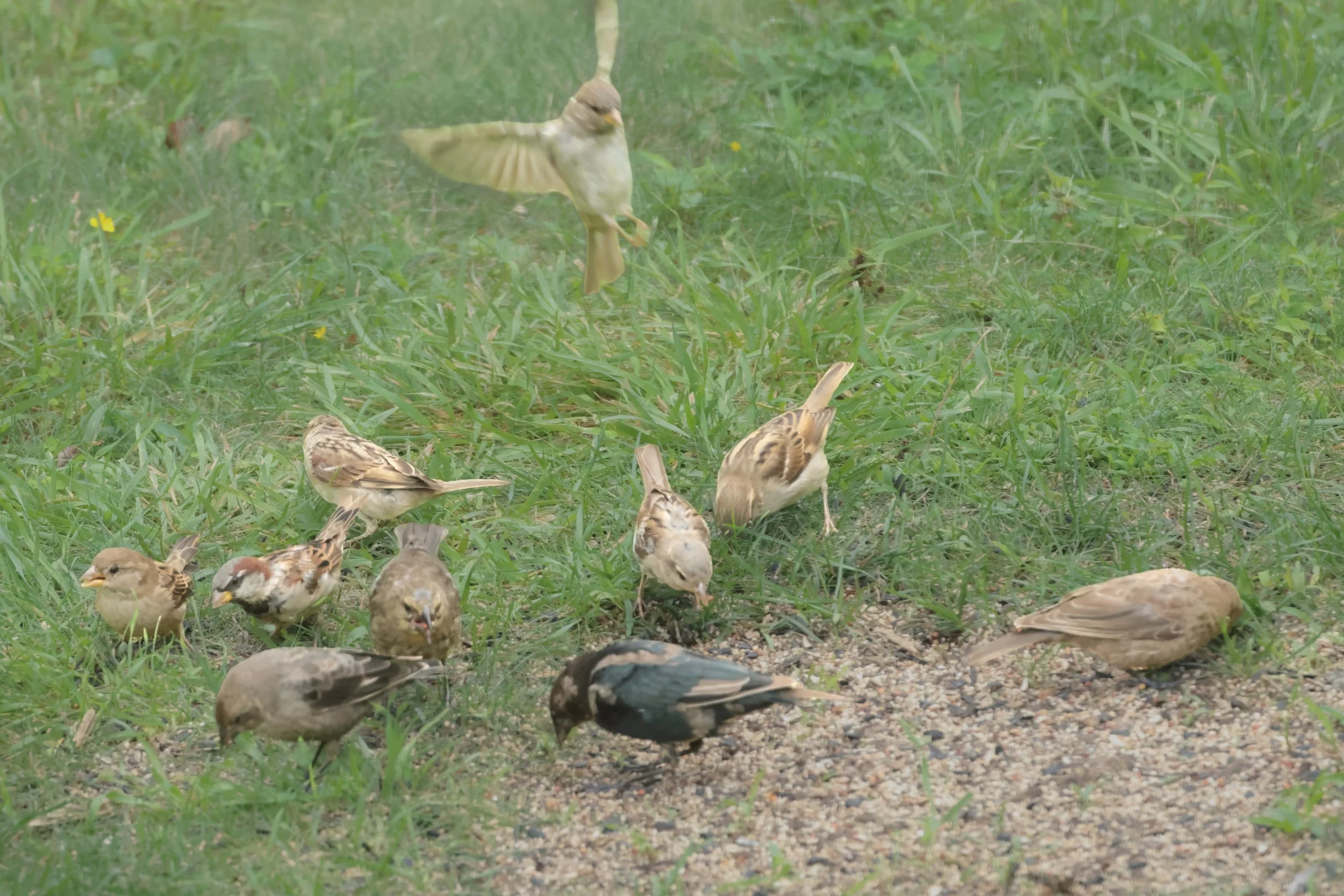
Eating With One Eye Open
Why do the chickadees, juncos and chipmunks at your feeder never seem to relax, and what that costs them.
I've spent a lot of mornings filming my bird feeder, and after a while I started to notice a pattern. A chickadee lands, grabs a sunflower seed and is gone. A junco on the ground below pecks twice, then freezes with its head up. A chipmunk stuffs its cheeks so full it looks lopsided, then bolts for cover. Nobody out there eats the way I do at my kitchen table. Every bite comes with a look around.
That constant checking isn't nervousness for its own sake. It's one of the oldest problems in nature: how do you eat when you might be eaten?
Every bite is a gamble
Biologists have a name for what you're seeing: the foraging–vigilance trade-off. A bird with its head down can find food but can't see a hawk coming. A bird with its head up can see the hawk but isn't eating. It can't fully do both at once, so it switches back and forth, all day long.
So, is it common in all wildlife? For prey animals, almost universally yes. Deer, rabbits, ducks, fish and even many insects show some version of it. Predators aren't exempt either. A fox at a carcass keeps an eye out for coyotes.
More eyes, less worry
One way around the problem is to bring friends. In a group, each animal can look up a little less often because someone else is probably watching. This "group-size effect" has been recorded in dozens of bird and mammal species (Elgar 1989). It's part of the reason chickadees, titmice, nuthatches and woodpeckers often travel together through winter woods and arrive at your feeder as a loose crew.
And those groups talk. Black-capped chickadees are famous for it. When researchers presented them with live predators, the birds changed their mobbing calls depending on how dangerous the predator was. Small, agile hunters like pygmy-owls drew more urgent calls, often with extra "dee" notes, than large, clumsy ones like great horned owls (Templeton, Greene & Davis 2005).
Here's the part that matters for your chipmunks. Other species listen in. In a study in New York's Hudson Valley, eastern chipmunks feeding at experimental food trays quit eating sooner when researchers played tufted titmouse mobbing calls (Schmidt et al. 2008). The titmouse alarm seemed to worry them more than the call of a hawk itself. So, when the birds at your feeder suddenly go quiet or start scolding, the chipmunk below is very likely paying attention.
Does all that worry take a toll?
It does, and the evidence is striking. For a long time, ecologists assumed predators mattered mostly through the animals they killed. Fear was seen as a passing thing. A bird got startled, flew off, and that was the end of it.
A 2011 experiment changed that thinking. Liana Zanette and her colleagues protected song sparrow nests on small islands in British Columbia with electric fencing and netting, so no predator could reach them. Then, through a whole breeding season, they played recordings near the nests. Some pairs heard predators like raccoons, crows and hawks. Others heard harmless animal sounds. The frightened parents laid fewer eggs and fed their young less often. In the end they raised about 40% fewer offspring, even though nothing ever attacked them (Zanette et al. 2011).
Researchers now call this the "ecology of fear." Living under constant threat can raise stress hormones for long stretches and, in some studies, leave lasting changes in the brain, much like chronic stress does in people (Clinchy, Sheriff & Zanette 2013). In other words, being watchful keeps an animal alive today, but being frightened all the time has real costs for its body and its family.
Clever ways to cope
The animals at your feeder aren't helpless, though. Many of their quirks are really workarounds for this exact problem.
Chipmunks pack and run. Those stretched cheek pouches let a chipmunk grab a big load fast and eat or store it later in the safety of its burrow.
Chickadees and nuthatches take one and go. They rarely sit and eat at the feeder. They carry a single seed to a nearby branch, or hide it for later, which keeps their time in the open short.
Squirrels bury nuts. Caching spreads the food out and lets them eat when and where they feel safe.
Small birds stay light. You might expect birds to pack on as much fat as possible before a cold night. But extra weight makes them slower to escape a hawk. A long-term study of great tits in Britain found their body mass shifted as sparrowhawk numbers rose and fell, with the birds carrying less fat when hawks were common (Gosler, Greenwood & Perrins 1995). They were balancing the risk of starving against the risk of being caught.